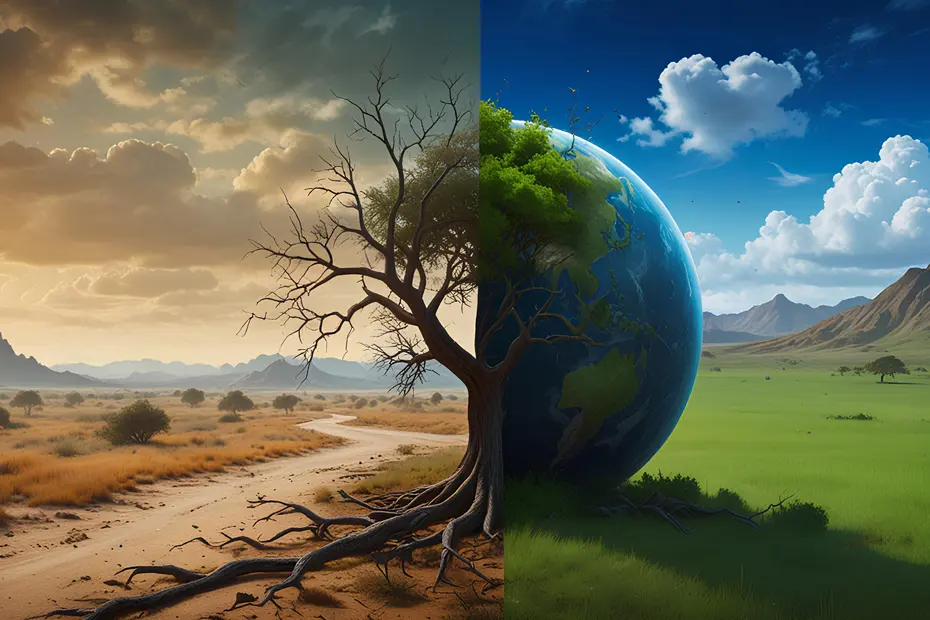

What Is Climate Change?
Climate change refers to long-term shifts in temperatures and weather patterns. These shifts can occur naturally due to changes in solar activity or major volcanic eruptions. However, since the 1800s, human activities have been the primary driver of climate change, mainly due to the burning of fossil fuels such as coal, oil, and gas.
Burning fossil fuels generates greenhouse gas emissions that act like a blanket around the Earth, trapping the sun’s heat and increasing global temperatures.
The main greenhouse gases contributing to climate change are:
- Carbon dioxide (CO2)
- Methane (CH4)
Major emission sources include:
- Energy production
- Industry
- Transport
- Buildings
- Agriculture
- Land-use change and deforestation
Humans Are Responsible for Global Warming
Climate scientists confirm that human activities have been the dominant cause of global warming over the past century.
The Earth’s surface temperature is now approximately 1.2°C higher than in the late 1800s (pre-industrial period). The last decade (2011–2020) was the warmest on record.
Climate change impacts include:
- Severe droughts
- Water scarcity
- Wildfires
- Rising sea levels
- Flooding
- Melting polar ice
- Stronger storms
- Biodiversity loss
How Climate Change Affects People
Climate change affects health, food security, housing, employment, and safety. Vulnerable communities — particularly small island nations and developing countries — face higher risks.
Sea-level rise, saltwater intrusion, and prolonged droughts are already forcing communities to relocate. Climate-related displacement is expected to increase in the future.
Every Degree of Warming Matters
According to UN scientific reports, limiting warming to 1.5°C would significantly reduce the worst climate impacts. However, current policies could lead to approximately 3°C warming by the end of the century.
The largest emitters (China, USA, India, European Union, Indonesia, Russia, and Brazil) account for nearly half of global emissions.
While climate action is a global responsibility, countries contributing more emissions bear greater responsibility for leading mitigation efforts.
Solutions to Climate Change
Climate solutions can generate economic benefits while protecting the environment. Key global frameworks include:
- Sustainable Development Goals (SDGs)
- UN Framework Convention on Climate Change (UNFCCC)
- Paris Agreement
Three Main Action Areas
- Mitigation: Reducing greenhouse gas emissions
- Adaptation: Preparing for climate impacts
- Climate Finance: Funding sustainable transitions
To stay below 1.5°C warming:
- Global emissions must be reduced by 50% by 2030
- Net-zero emissions should be achieved by 2050
- Two-thirds of known fossil fuel reserves must remain unused
Early warning systems, resilient infrastructure, and sustainable energy transitions offer high returns on investment.
Weather vs. Climate
Weather
Weather describes short-term atmospheric conditions (e.g., rain, wind, storms).
Climate
Climate describes long-term weather patterns in a region, typically measured over 30 years or more.
While daily weather varies, long-term warming trends show a clear increase in global temperatures. The past five years have been among the warmest on record.
What Causes Climate Change?
Greenhouse gases trap heat in the atmosphere — this is known as the greenhouse effect. Human activities increase greenhouse gas concentrations, intensifying this effect and causing global warming.
Key contributors include:
- Fossil fuel combustion
- Industrial processes
- Deforestation
- Agricultural emissions
Does Human Action Matter?
Yes. Human actions directly influence global climate systems. The Earth functions as an interconnected system involving the atmosphere, oceans, land, ecosystems, and solar energy.
Scientific monitoring systems, including satellite observations, continuously track changes in Earth’s systems.
Conclusion
While Earth’s climate has changed naturally over history, scientific consensus confirms that the rapid warming observed in the past century cannot be explained by natural causes alone. According to the IPCC, human activities are the primary driver of modern climate change.
Addressing climate change requires immediate, coordinated global action to reduce emissions, enhance resilience, and transition toward a sustainable future.