Life Cycle Assessment & Environmental Product Declaration & Product Environmental Footprint (PEF)
A Life Cycle Assessment (LCA) is a methodology used to assess the environmental impacts associated with the entire life cycle of a product or process. LCA consists of four main stages:
- Goal and Scope Definition
- Inventory Analysis
- Impact Assessment
- Interpretation and Reporting
LCAs follow standardized procedures, often aligned with Product Category Rules (PCRs), and help quantify carbon footprint and natural resource use. LCA data serves as the foundation for developing an Environmental Product Declaration (EPD).
What Is an Environmental Product Declaration (EPD)?
An Environmental Product Declaration (EPD) is a standardized report that transparently communicates the environmental performance of a construction product or material over its life cycle.
EPDs help engineers and designers:
- Identify sustainable alternatives
- Estimate a project’s carbon footprint
- Select environmentally optimized materials
EPDs are developed according to standards such as ISO 14025 and, in construction, EN 15804.
Why Is This Important for the Industry?
The construction industry is moving toward mandatory environmental transparency. Increasing legislation requires contractors and manufacturers to provide LCAs and EPDs before project execution.
For example:
- California legislation promotes embodied carbon reporting.
- Caltrans requires contractors to collect EPDs for construction materials used in public projects.
EPDs are increasingly included in procurement criteria and sustainability certifications and can be used to calculate the climate impact of entire buildings.
Product Environmental Footprint (PEF)
A Product Environmental Footprint (PEF) study is an LCA conducted according to the European Commission’s PEF methodology.
The PEF framework defines:
- Specific modeling requirements
- Calculation procedures
- Reporting formats
For certain product categories, PEF Category Rules (PEFCR) provide additional product-specific guidance.
PEF aims to standardize product environmental comparisons across the European market and may form the basis for future environmental labeling requirements.
The Difference Between LCA, EPD, and PEF
- LCA (Life Cycle Assessment): A scientific method to quantify environmental impacts throughout a product’s life cycle.
- EPD (Environmental Product Declaration): A standardized, third-party verified report summarizing LCA results.
- PEF (Product Environmental Footprint): A structured LCA methodology defined by the EU.
LCA can be used for internal decision-making and external communication. When communicating publicly or meeting procurement requirements, an EPD is often necessary.
Life Cycle Assessment (LCA) Explained
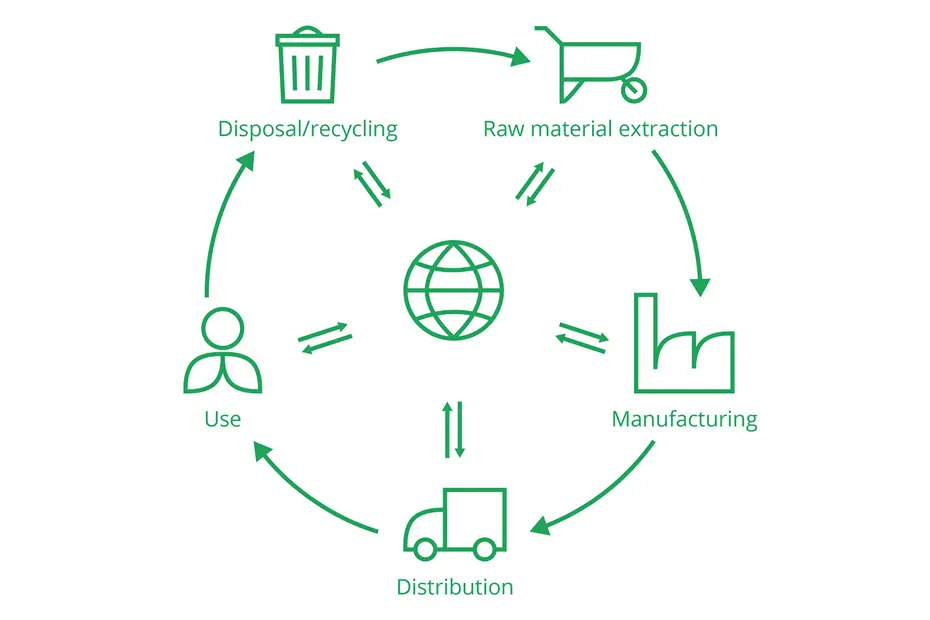
LCA is defined under ISO 14040 and ISO 14044 and evaluates environmental impacts from raw material extraction to end-of-life disposal (cradle-to-grave).
An LCA assesses:
- Energy consumption
- Air, water, and soil emissions
- Waste generation
- Resource use
- Multiple environmental impact categories
LCAs help identify environmental hotspots and guide improvement strategies, such as transitioning to renewable energy in production processes.
Environmental Product Declaration (EPD) Explained
An EPD is derived from an LCA but presented in a standardized format that excludes sensitive business information.
EPDs:
- Follow ISO 14025 and relevant PCRs
- Require third-party verification
- Are published in EPD databases
EPD databases allow stakeholders to compare products based on verified environmental data.
Choosing the Right Methodology
The appropriate methodology depends on your objective:
- LCA: For detailed internal environmental analysis.
- EPD: For transparent external communication and procurement requirements.
- PEF: For EU-aligned standardized comparison.
Business Benefits of LCA and EPD
- Competitive advantage in public and private tenders
- Identification of environmental bottlenecks
- Quantification of greenhouse gas emissions
- Reduction of product carbon footprint
- Comparable results using declared units (m², m³, kg, ton)
Conclusion
Monitoring and reducing greenhouse gas emissions is now critical for businesses and organizations. Measuring product sustainability through LCA and EPD provides insight into environmental impacts, future risks, and cost-saving opportunities.
By identifying emission-intensive processes, companies can implement energy efficiency measures and strengthen long-term sustainability performance.